
Electric Machine Design Lab — EE 4422
Director: Mehdi Farasat
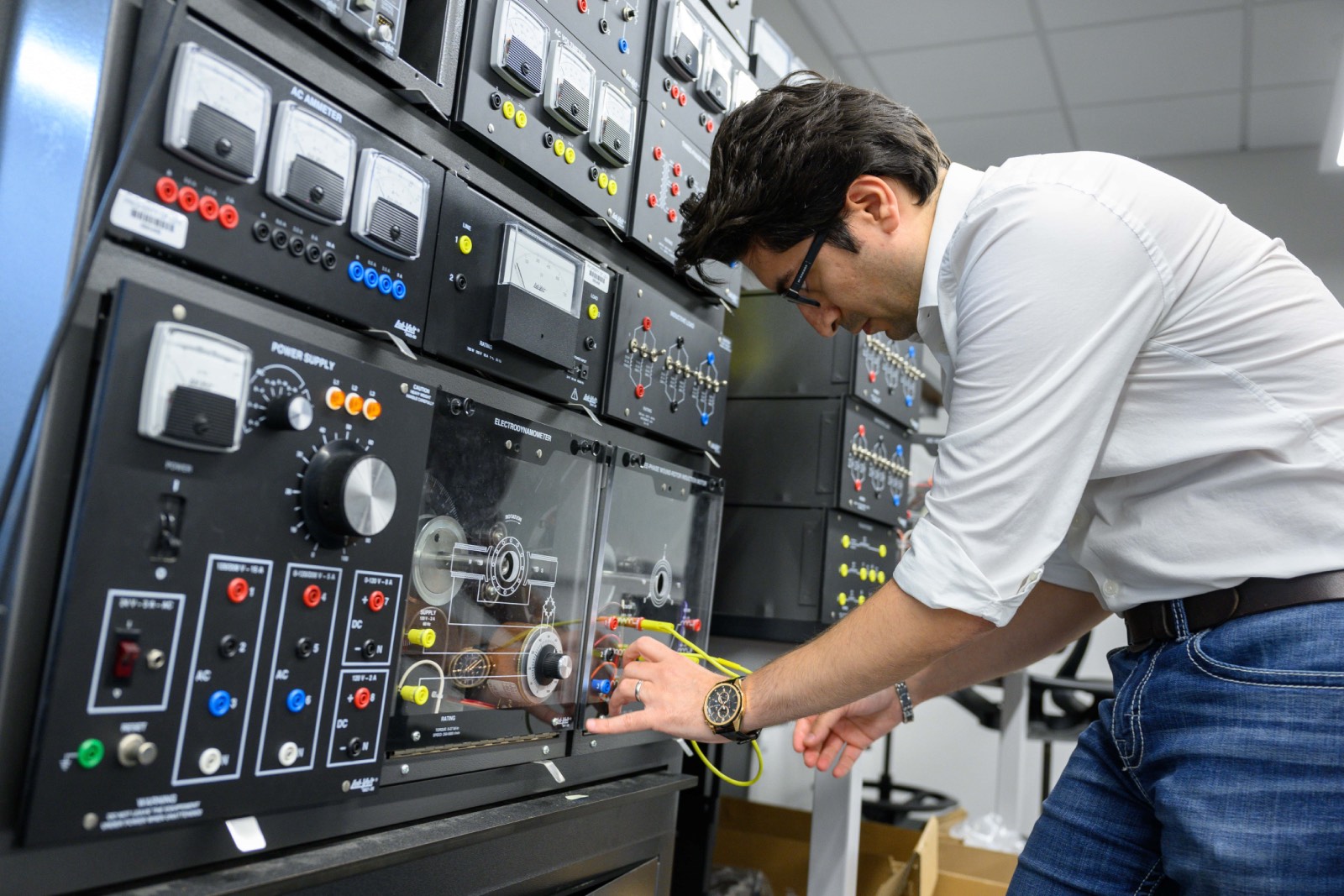
Electric Machine Design Lab introduces students to the major components of power systems, such as single- and three-phase transformers, synchronous generators, and single- and three-phase induction motors.
Major Equipment
- Fixed and variable single- and three-phase AC and DC power supply modules, single- and three-phase transformer modules and synchronous machine modules.
- Three-phase wound-rotor and squirrel-cage induction motor modules, single-phase capacitor-run induction motor modules, brushed and brushless DC machine modules, and dynamo-meter modules.
- AC and DC amp meter and volt meter modules, single- and three-phase watt meter modules, and various R-L-C load modules.
- Hand-held tachometers and digital multimeters
Sponsors
Equipment sponsored by the National Science Foundation and LSU College of Engineering.
Lab Goals
The students conduct experiments to obtain steady-state characteristics of major components of power systems, such as:
- Voltage regulation of transformers and synchronous generators under various loads
- Torque-speed characteristics of induction motors
- Active and reactive power generation capacity of synchronous generators under different excitation and load conditions.
Description
Experiments are designed to familiarize students with the operating principles of major components in power systems. Transformer experiments introduce concepts such as voltage, current, and turns ratio in single-phase transformers, as well as Wye and Delta connections in three-phase systems.
Students also perform open-circuit and short-circuit tests and study voltage regulation under different load conditions. Through synchronous machine experiments, students examine voltage regulation under varying loads, learn how to adjust terminal voltage by controlling excitation current, and explore how a synchronous motor's power factor can be shifted from lagging to unity or leading by excitation control.
In three-phase induction motor experiments, students operate the motor under different load conditions, measure speed to determine torque-speed characteristics, calculate input and output power, and evaluate efficiency across a range of operating conditions.